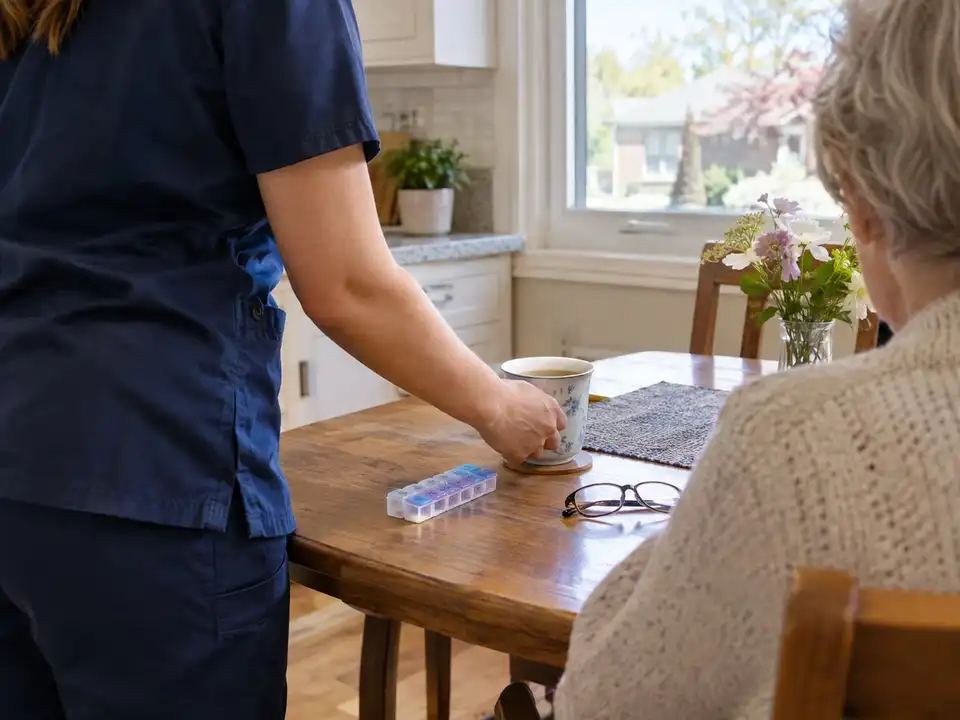
ReverseMortgageBurlington.ca explains how Burlington homeowners pay for home care so they can stay in the house they know. Home care in Burlington comes from two places: the public system, which is free but limited, and private help, which the family pays for.
The private part can be paid from your home’s value with a reverse mortgage, which has no required monthly mortgage payments. You keep paying the property taxes, the home insurance and the upkeep yourself.
What happens when you first ask
You start with the free estimate form. It asks a few plain questions: your age, your home’s rough value, anything you still owe on it, and what the money is for. Getting an estimate doesn’t affect your credit.
Then each lender is looked at for your home, and the best deal comes to you by email. Richard Hopkins, Mortgage Broker, compares every reverse mortgage lender in Canada for you. Because Richard also arranges home equity lines of credit and refinances, the email recommends whichever option gives you the best overall value, reverse mortgage or not.
Each email can also go to your adult children, and a three-way phone or video call takes little effort to arrange. Nothing is signed at this stage. The full process has seven steps, from the estimate to closing, and you can stop at any one of them.
What Ontario pays for at home, and what it doesn’t
Publicly funded home care in Ontario is arranged by Ontario Health atHome. A care coordinator assesses your needs, writes a care plan and sends nursing, therapy or personal support through its own staff or a contracted agency. If you qualify, the province pays for that care (Ontario.ca, home and community care, updated May 5, 2026).
The number of hours depends on your assessed needs and on what is available in your community. The same provincial page says you can also pay private companies for care. That private layer is the part a family pays for, and it is the part a reverse mortgage can cover.
Ontario’s listings for Burlington long-term care homes point residents to the Hamilton Niagara Haldimand Brant area of Ontario Health atHome. Call that office first. A public assessment costs nothing, and it shows how many hours of help the province will provide before you budget for the rest.
Help Halton Region offers in Burlington
Halton Region lists two Burlington supportive-living programs, at Wellington Terrace and Bonnie Place. They provide on-site personal care, meal support and light housekeeping to older adults in set neighbourhoods around those buildings, and Halton lists no fee for them (Halton Region). Places are limited by the program’s rules, so ask early.
How a reverse mortgage pays for private care
A reverse mortgage turns part of your home’s value into money you can spend on care, while you keep living in the house. The amount depends on the youngest borrower’s age and the home’s value. The most you can borrow is about 50.5% of the value at 65, about 58% at 75, and about 60% at 78 and older.
You choose how the money arrives. Monthly deposits suit a steady care schedule, such as a personal support worker three mornings a week.
A lump sum suits a one-time cost, such as making the bathroom safer. You can also use both.
Interest is charged only on the money you take. An amount you leave untouched costs nothing. You don’t have to take the full amount you qualify for, and a smaller balance keeps more room for later years.
Because the money is borrowed, it is not taxed, and your Old Age Security (OAS) and Guaranteed Income Supplement (GIS) are not reduced. Interest on money left sitting in a bank account is taxable income, so drawing it as care bills arrive is usually tidier.
An illustrative example at Burlington’s benchmark price
For example, picture a composite widow of 80 whose Burlington home is valued at $854,500, the city’s MLS Home Price Index benchmark for September 2026 (Cornerstone Association of REALTORS). At 80, the most she could borrow is about 60% of $854,500, so about $513,000.
She still owes $30,000 on a home equity line of credit. That $30,000 is paid off first out of the mortgage money, so about $483,000 is left for her to use. She doesn’t take anywhere near $483,000.
She takes $25,000 at closing for a stair lift and the first months of private care. Then $1,500 a month arrives by deposit to pay a personal support worker on top of the hours Ontario Health atHome provides. Her balance starts at $55,000 ($30,000 plus $25,000) and grows only as each $1,500 deposit is taken.
Her son is copied on every email.
If care needs grow
When the last borrower moves into long-term care for good, the reverse mortgage becomes payable. The family then gets six months to a year, depending on the product, to sell the home or repay the balance. A temporary hospital or rehab stay doesn’t trigger anything. Neither does a dementia diagnosis, or one spouse moving into care while the other borrower stays home.
Reverse mortgage money also doesn’t count as income for the income-tested reduction on a basic long-term care room. A house you own isn’t counted either (Ontario Ministry of Long-Term Care). The guide to long-term care in Burlington sets out the 2026 room rates and waiting lists, and the guide to retirement home costs in Burlington covers the private route.
What it costs and how it is repaid
Advertised five-year fixed rates ranged from 6.23% to 6.94% across the four lenders, checked September 17, 2026. Interest isn’t paid monthly. It is added to the balance and compounds twice a year.
The one-time bill is usually $2,000 to $3,500. It pays for the appraisal, the lender’s set-up fee and your independent legal advice (roughly $800 to $1,200 in Ontario).
Your only in-person meeting is that independent legal advice (ILA), a short visit to your lawyer’s office. There is no charge to you for the broker, since the lender pays the brokerage after the mortgage has funded.
The loan stays in place for as long as a borrower lives in the home. It is paid back after a sale, after the last borrower’s permanent move out, or after the last borrower’s death. Even then, as long as you kept up the property taxes, insurance and upkeep, the debt can’t be larger than the home’s fair market value at the time the mortgage becomes due. It’s typically called the no negative equity guarantee, and all four lenders offer it.
The balance rises as interest is added. Higher home prices over the same period often cover some of that or all of it, and borrowers in Canada hold on to about half their equity on average. The Burlington reverse mortgage calculator shows the most you could borrow at your age, what is left after debts, the amount five years older and the cost of moving instead, and recent Burlington home prices show where values stand today.
Repaying early, in the first few years, usually costs a charge that shrinks over time. It is either a percentage of the amount repaid or a few months’ interest. Some lenders allow up to 10% a year to be repaid without a charge.
The full list of fees is in the guide to reverse mortgage costs in Burlington.
What Richard does for you on this
- A free estimate of what your Burlington home could provide
- Every reverse mortgage lender in Canada compared for your situation
- Lines of credit and refinances weighed too, for the best overall value
- All four lenders weighed, and the best deal for your home sent by email
- Care money paid as monthly deposits, one lump sum or a mix
- Family copied on every email, plus three-way calls when you want them
- The application, appraisal and lender paperwork handled for you
- A referral to an independent lawyer for your legal advice, if you need one
Burlington guides on this topic
- Long-term care in Burlington: costs, waiting lists and your home
- How much does a retirement home cost in Burlington?
- What does a reverse mortgage cost in Burlington?
- What are Burlington home prices in 2026?
Sources
Figures checked October 15, 2026.
- Ontario.ca, Home and community care (updated May 5, 2026)
- Ontario Health atHome
- Halton Region, Assisted living and supports for daily living programs
- Cornerstone Association of REALTORS, market update September 2026 (released October 5, 2026)
- Ontario Ministry of Long-Term Care, Paying for long-term care (updated July 10, 2026)