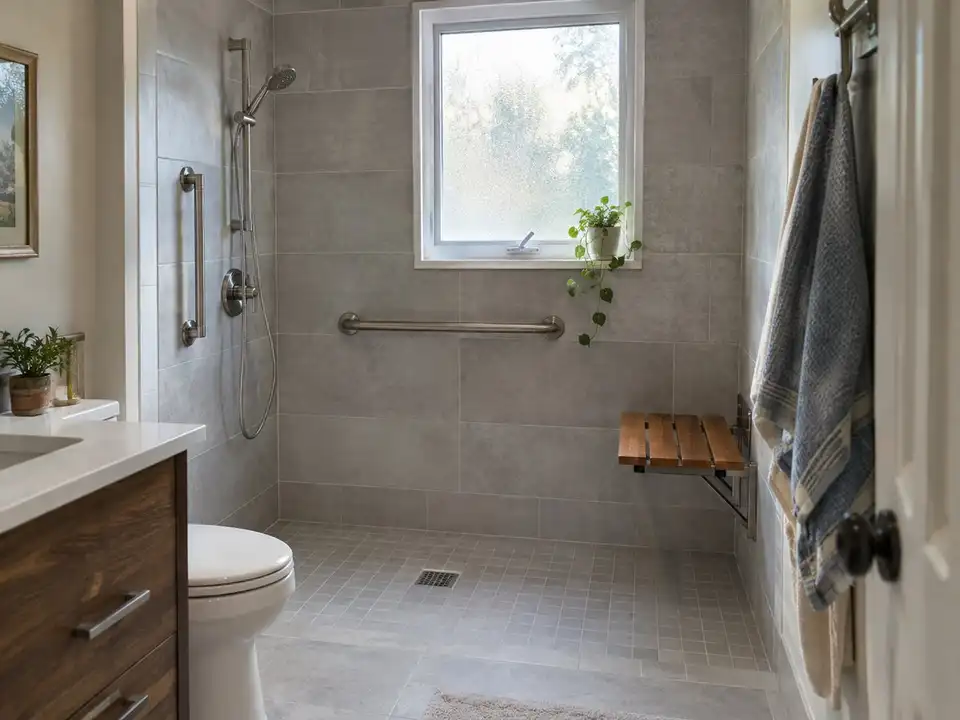
ReverseMortgageBurlington.ca explains how Burlington homeowners 55 and older can pay for accessible home renovations from the value of their home. Accessible home renovations in Burlington often mean a walk-in shower, grab bars, a stair lift, a ramp or a main-floor bedroom. A reverse mortgage can pay for that work with no required monthly mortgage payments, so you can stay in your home.
What happens when you first ask
The first step is the free estimate form. It asks for the age of the youngest owner, a rough value for the home, and what is still owed on it. Asking for one leaves your credit untouched.
After that, you get a look across all four lenders and the best deal for your Burlington home, in your inbox. It comes from Richard Hopkins, Mortgage Broker, who compares every reverse mortgage lender in Canada. A son or daughter can be copied on every email, and three-way phone calls are welcome. You decide what happens next.
It helps to mention what the work is for, such as a bathroom, stairs or an entrance. If you already have contractor quotes, a rough total is useful, but it isn’t needed to get started.
Nothing gets signed at this stage. The estimate and that email are the first two of seven steps, and you can stop at any point along the way.
The only meeting in person is a short visit to your own lawyer before closing.
Why Burlington homes may need changes
About 47% of Burlington homes were built before 1981, and a third were built between 1961 and 1980 (Statistics Canada, 2021 Census Profile, Burlington). Homes of that age can have tub showers, narrow doorways and a bathroom only on the second floor.
The city’s population is older too. In the 2021 Census, 21.0% of Burlington residents were 65 or older and 3.3% were 85 or older, and about three in four households owned their home (Statistics Canada, 2021 Census Profile, Burlington).
A home that works on one floor can mean you don’t have to move. If help at home is part of the plan too, the page on paying for home care in Burlington covers that cost.
Help to check before you borrow
Some money for accessible changes may come from programs and tax credits, so check them first. A reverse mortgage can then cover the rest.
The federal Home Accessibility Tax Credit
If you’re 65 or older at the end of the year, or eligible for the disability tax credit, you can claim up to $20,000 of eligible home accessibility expenses a year (Canada Revenue Agency). Work by plumbers, electricians and carpenters counts, and so do materials and permits. The credit is non-refundable, which means it lowers the tax you owe but isn’t paid out on its own.
Halton Region programs
Halton Region has run an accessibility repair program for things like stair lifts, walk-in showers, grab bars and ramps. Its accessibility plan describes the program for 2022 and 2023, with funding given first come, first served (Halton Region). Ask Halton whether it is open in 2026 before you count on it.
If the work includes the basement, Halton’s flooding subsidy pays 50% of a backwater valve, up to $1,600, and 100% of a weeping tile disconnection with a sump pump, up to $6,500, when an approved contractor does the work (Halton Region, backwater valve subsidy; Halton Region, weeping tile subsidy).
How the lender looks at the home
The condition of your home is part of the lender’s review. If a repair is already booked, the lender can sometimes include it and hold part of the money until the job is finished. When a house is in very poor shape, the fix can be a short private loan to do the work first, paid off later by the reverse mortgage.
An illustrative example: an $854,500 Burlington home
Take an illustrative widow, age 75, who lives in a two-storey house with the only full bathroom upstairs. Her home appraises at $854,500, the same as Burlington’s MLS Home Price Index benchmark in September 2026 (Cornerstone, September 2026).
At 75, a borrower can get up to about 58% of the home’s value. On $854,500, that ceiling is about $493,000. She still owes $30,000 on her old mortgage, which is paid off first from the same money, leaving about $463,000 ($493,000 minus $30,000).
Her contractor quotes for a main-floor walk-in shower and a stair lift total $70,000 in this example. She takes $100,000 in all: $30,000 to clear the mortgage and $70,000 for the work. Interest is charged only on the $100,000, and the other $393,000 or so stays untouched.
You can test your own figures in the Burlington reverse mortgage calculator.
What it costs and how it is repaid
The lenders’ advertised five-year fixed rates were 6.23% to 6.94%, checked September 17, 2026. No lender sets a different rate for Burlington.
Expect one-time costs of roughly $2,000 to $3,500 in all. That covers the appraisal, the lender’s set-up fee and your own lawyer’s independent legal advice, which runs about $800 to $1,200 in Ontario.
Richard charges you nothing, because the lender pays the brokerage once the mortgage funds. The guide to reverse mortgage cost in Burlington lists each item.
There are no required monthly mortgage payments. You remain responsible for the property taxes, the home insurance and the upkeep.
The interest is added to the balance, and rising home prices often offset some or all of it. On average, Canadian borrowers keep about half their equity.
The loan is settled after one of three things: the house is sold, the last borrower leaves it permanently, or the last borrower dies. If the taxes, insurance and upkeep have been looked after, the bill can’t be bigger than the home’s fair market value at the time the mortgage becomes due. It’s typically called the no negative equity guarantee, and all four lenders offer it.
Paying the loan off early is always allowed. A charge usually applies in the first few years, either a percentage of what you repay or a few months’ interest, and it gets smaller each year. Some lenders also accept up to 10% of the balance back each year with no charge at all.
If the home may one day stop working even after changes, the guide to long-term care in Burlington explains what a permanent move means for the loan. Current values across the city are in the guide to Burlington home prices.
What Richard does for you on this
- Estimates how much your home could provide for the renovation
- Compares every reverse mortgage lender in Canada for your situation
- All four lenders weighed, and the best deal for your home sent by email
- Copies your family on every email if you want them included
- Explains how much to take now and how much to leave untouched
- Checks how planned repairs fit with the lender's review of the home
- Points you to tax credits and programs to check before you borrow
- Keeps track of the appraisal and each step through to closing
Burlington guides on this topic
- What does a reverse mortgage cost in Burlington?
- What are Burlington home prices in 2026?
- Long-term care in Burlington: costs, waiting lists and your home
Sources
Figures checked October 15, 2026.
- Statistics Canada, 2021 Census Profile, Burlington
- Canada Revenue Agency, Line 31285 Home accessibility expenses (modified July 24, 2026)
- Halton Region, 2024-2028 Accessibility Plan update (July 2025)
- Halton Region, Backwater valve installation subsidy
- Halton Region, Weeping tile disconnection and sump pump installation subsidy
- Cornerstone Association of REALTORS, market update, September 2026 (released October 5, 2026)